


Why Your Business Must Own Its Domain Name: The Risks of Giving Domain Control to Anyone
Your domain name is one of your business’s most
important digital assets. Never give away control
Domain Name vs. Domain Registrar Vs
Web Host: What’s the Difference?
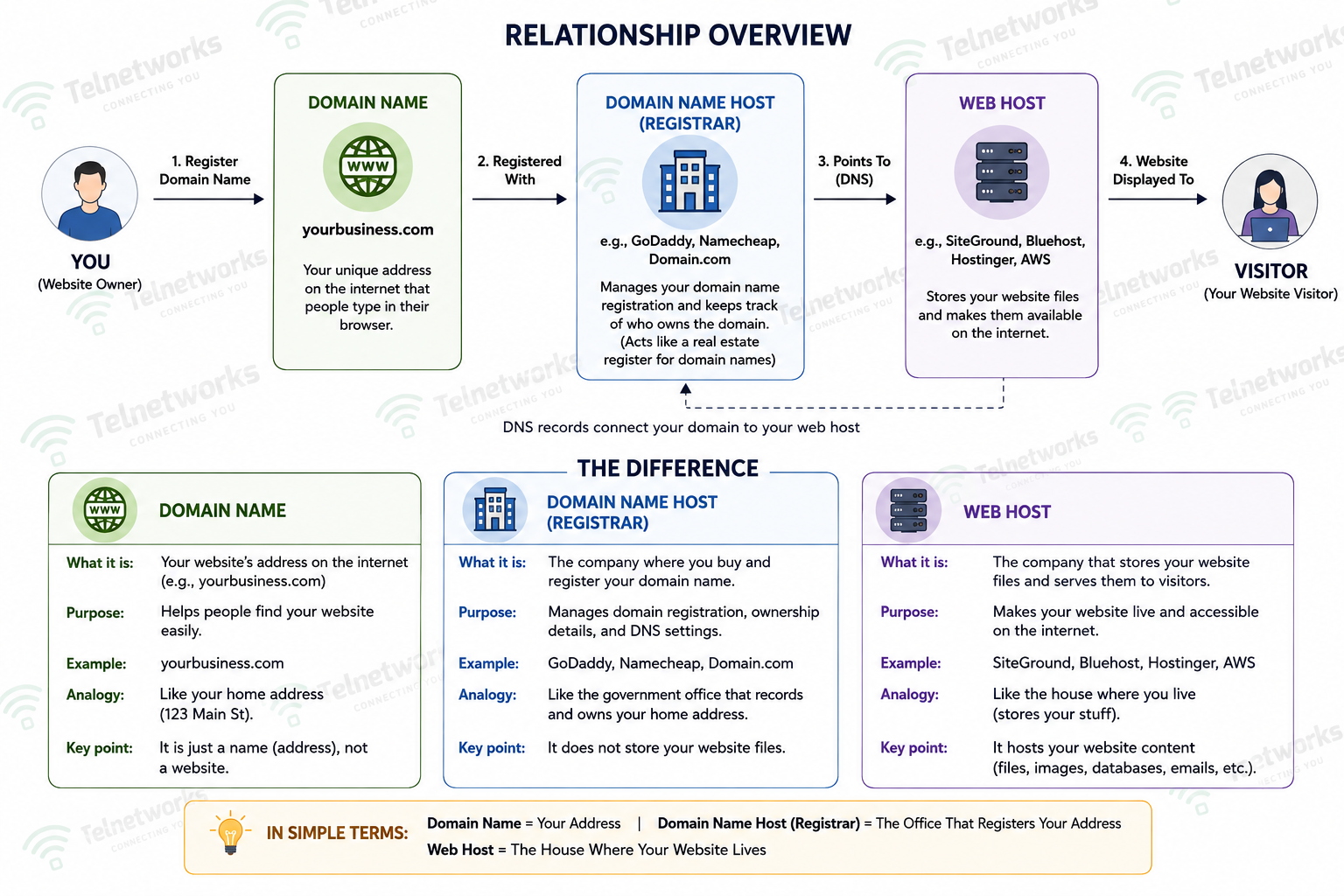
As an absolute first step, you must first understand the distinctions between a Domain Name, Domain Registrar and Web Host.
Although these terms are closely related, they refer to three completely different things.
Understanding the difference is important because each one has a different job in getting your domain online and operational.
What Is A Domain Name?
A domain name is the address people type into their browser to visit your website.
For example:
- telnetworks.com.au
- telnetworks.net.au
- telnetworks.net
- telnetworks.network
- telnetworks.global
- telnetworks.au
A domain name generally consists of two main parts:
- The name: telnetworks
- The extension (top-level domain): .com.au or .net.au or .net or .global from the above example
There are a whole array of extensions to choose from. Some other popular extensions include .org, .co.uk, .co.nz and many more.
It’s important to understand that buying a domain name doesn’t automatically give you a website.
The domain is simply the address people use to find your website.
Think of it like a street address for a house. The address tells people where to find you, but the address itself isn’t the house.
What Is A Domain Registrar?
A domain registrar is a company or organisation that allows you to register and manage domain names.
For example, you might use a registrar to search for a domain such as telnetworks.com.au and, if it’s available, register it for a certain period of time.
For .com.au domain names, the standard registration period is 2 years. At the end of the 2 year term, you must renew registration of your domain name.
When you register a domain, you’re essentially obtaining the right to use that domain name for a specific period. You can then renew it to continue using it.
A Domain Registrar’s purpose is to typically let you:
- Register a new domain
- Allocate Name Servers to that particular Domain Name
- Renew your domain
- Transfer a domain to another registrar
- Change your domain’s settings
- Set up domain-related services
It’s also worth noting that you don’t technically “own” a domain name forever. You register it and maintain the registration as long as you continue renewing it.
What Is A Web Host?
A web host, or web hosting provider, is the company that provides the server space where your website’s files are stored.
Your website might contain:
- HTML files
- Images
- Videos
- CSS files
- JavaScript
- Databases
- Other application files
A web host stores these files on servers connected to the internet so that visitors can access your website.
How Do They Work Together?
The Importance of A Domain Name To A Business
For many businesses, a domain name is simply the address customers type into their browser to find a website. But a business domain name is much more than that.
Your domain name is one of your business’s most important digital assets.
It can represent your brand, your online identity, your business email, your search engine presence, your advertising campaigns, your customer relationships and years of accumulated digital reputation.
Despite this, many businesses make a serious mistake when setting up their website: they allow a web designer, developer, marketing agency, IT company, employee or other third party to register the domain in their own name and retain control of it.
This can create a significant business risk.
A third party may be perfectly trustworthy today. But businesses change. Employees leave. Agencies are replaced. Developers retire. Companies close. Partnerships break down. Contracts end. Disputes occur.
Domain Name Ownership Is Business Ownership
One of the most important principles every business owner should understand is the following concept.
Your domain name should be owned and controlled by your business, not by a third party working for the business.
- A web developer is a service provider.
- A marketing agency is a service provider.
- An IT company is a service provider.
- An SEO consultant is a service provider.
None of these roles automatically gives someone a legitimate reason to own your company’s domain.
- They may need access to manage the domain.
- They may need access to DNS records pertaining to the domain.
- They may need permission to update settings.
However, access is not the same as ownership.
You can give someone permission to manage an asset without transferring the asset to them.
This distinction is critical in the scope of Domain Name Management.
Your Domain Name Is A Business Asset
A domain name can become extremely valuable over time.
When a business launches, its domain might seem insignificant. But after years of operating under the same domain, it can become closely associated with the company’s brand.
- Customers remember it.
- Search engines recognize it.
- Other websites link to it.
- Advertising campaigns promote it.
- Business cards display it.
- Invoices reference it.
- Employees use it in email addresses.
The domain becomes part of the company’s identity.
In some circumstances, changing it can be enormously disruptive & maybe even disastrous to the business.
That means the domain should be treated as a genuine business asset rather than an administrative detail.
Your Website Can Be Rebuilt
Your Digital Reputation Cannot Easily Be Replaced
Businesses owners sometimes assume that if they lose their domain name, they can simply register another one.
Technically, they may be able to.
Practically, it can be a disaster.
Imagine your business has operated at the same domain name for ten years.
Over that time, your domain name may have accumulated:
- Thousands of back Links
- Search engine rankings
- Online reviews
- Brand recognition
- Customer bookmarks
- Printed references
- Advertising history
- Email addresses
- Social media references
- Industry citations
- Media coverage
Changing domains can create substantial disruption.
You may have to redirect traffic, update marketing materials, notify customers, change email addresses, update third-party platforms and work to rebuild your search engine visibility.
The old domain may represent years of digital investment.
Don’t put that investment at risk by allowing someone else to own the domain.
Your Business Email
Depends on Your Domain Name
This is one of the most overlooked risks of domain ownership.
Your website may go down and your business might still be able to operate.
But losing control of your domain can potentially create serious problems for your business email.
Consider how many systems may rely on addresses such as:
- sales @ yourbusiness.com
- accounts @ yourbusiness.com
- info @ yourbusiness.com
- support @ yourbusiness.com
Your domain could be associated with:
- Customer correspondence
- Supplier communications
- Invoices
- Banking notifications
- Government correspondence
- Software accounts
- Password recovery
- Customer accounts
- Employee accounts
- Contracts
If control of the domain is compromised, email services and account recovery processes can potentially be affected.
For this reason alone, domain security should be treated as a core part of the business cyber security scope.
Your Web Developer
Should Not Be the Gatekeeper to Your Business
A common scenario goes something like this.
A business hires a web developer to create a website.
The developer says:
“I’ll register the domain for you.”
- The business agrees.
- The website is built.
- Everything works.
For several years, nobody thinks about the domain.
Then the business decides to change developers.
The old developer becomes difficult to contact.
The business asks for the domain login or transfer.
Suddenly, there is confusion about who owns it.
This is exactly the situation businesses should avoid.
Your website developer should make it easier for you to run your business — not put themselves in a position where your business depends on them to access its own digital property.
People Leave. Businesses Change. Contracts End.
Even if you completely trust the person who currently manages your domain, consider what happens five years from now.
Your trusted individual/organization could:
- Sell their business
- Retire
- Move overseas
- Stop providing services
- Lose access to their own systems
- Close their company
- Become unresponsive
- Have a dispute with your business
- Experience a cyber security incident
The same applies to employees.
The same applies to agencies.
The same applies to contractors.
Good security isn’t based on assuming everyone will always remain available and trustworthy.
Good security is based on maintaining appropriate control regardless of what happens.
Domain Ownership Can Become a
Problem During a Business Dispute
One of the most serious scenarios occurs when a business relationship breaks down.
Suppose your company terminates a contract with a website developer or technology supplier.
- The third party company controls the domain.
- A disagreement develops over outstanding invoices.
- The developer refuses to transfer the domain until the dispute is resolved.
- Now your company may find itself in a difficult position.
- Your website may still be hosted somewhere else.
- Your business may still legally own its content.
- Your company may have paid for the website.
However, if another party controls the domain registration, you may not have immediate control over the address customers use to reach you.
This is why domain ownership should be established correctly before a dispute ever happens.
Don't Confuse Website Ownership
With Domain Ownership
Another common misunderstanding is assuming that owning your website means you own your domain.
They are different things.
Your website may consist of:
- Website files
- Images
- Databases
- Code
- Content
- Hosting
- Plugins
- Applications
Your domain is a separate asset managed through a domain registrar (as explained above).
You can own your website and still have somebody else controlling the domain.
That distinction is extremely important when buying a website, changing developers or acquiring a business.
Your Domain Registrar Account
Should Be Under Your Business Control
A strong domain ownership strategy starts with the registrar account.
The business should know:
- Which registrar holds the domain.
- Who has access to the account.
- Which email address is associated with the account.
- Who controls the recovery methods.
- Who receives renewal notifications.
- When the domain expires.
- Whether multi-factor authentication is enabled.
- Which third parties have administrative access.
Ideally, the primary account should be controlled by the business rather than by an individual contractor.
The business can then grant appropriate access to professionals who need it.
This creates a much safer structure.
Domain Management and
Domain Ownership Are Different
There is absolutely nothing wrong with using a professional to manage your domain.
In fact, businesses often should use experienced IT professionals or domain specialists for technical management.
At Telnetworks, we help manage thousands of domain names for Business’s across Australia.
The key is understanding the difference between the Domain Ownership and Domain Management.
A professional might manage:
- DNS records
- Name servers
- Email records
- Website connections
- Security settings
- Domain renewals
- Verification records
- Technical configuration
That doesn’t mean they need to own the domain.
Think about your accountant.
You might give your accountant access to financial information so they can do their job.
That doesn’t mean you transfer ownership of your bank account to them.
Your domain should be approached with the same principle.
Protect Your Domain From Cyber Security Threats
Domain name security is also an important cyber security issue.
If someone gains unauthorized access to your registrar account, they may potentially be able to make changes that affect where your domain points.
Depending on the circumstances, an attacker could attempt to:
- Change DNS records
- Redirect website traffic
- Disrupt email
- Change account details
- Attempt to transfer the domain
- Redirect visitors to malicious websites
A compromised domain can therefore become a serious security incident.
Businesses should use strong, unique passwords and multi-factor authentication where available, restrict account access and regularly review who has administrative permissions.
Keep Your Domain Registration Details Accurate
Businesses should also make sure their domain registration information remains accurate and up to date.
If the domain is registered using the details of a former employee, developer or contractor, that should be treated as a warning sign.
Your organisation should know exactly who the registered holder is and how the domain can be recovered or transferred if necessary.
This is particularly important when a business changes ownership, restructures or changes its service providers.
Never Let Your Domain Expire Accidentally
Domain ownership also means maintaining the registration.
A domain that expires can potentially create enormous problems.
Businesses should maintain accurate billing information and make sure renewal notifications reach someone who is responsible for monitoring them.
Where appropriate, automatic renewal can provide additional protection against accidental expiration.
Don’t rely entirely on one individual receiving an email reminder.
A business-critical asset should have a business process behind it.
Domain Ownership Should Be Addressed in Contracts
Businesses working with web developers, agencies and IT providers should consider addressing domain ownership explicitly in their agreements.
A contract can clarify:
- Who owns the domain
- Who is responsible for registration
- Who controls the registrar account
- Who is permitted to manage DNS
- What happens when the contract ends
- How access is transferred
- What happens if the provider becomes unavailable
- Who is responsible for renewal
Clear agreements can prevent misunderstandings later.
For businesses with valuable domains, obtaining appropriate legal advice about contractual arrangements can also be worthwhile.
What Should You Do If Someone Else Currently Owns Your Domain?
If your domain is currently registered in someone else’s name, don’t panic — but don’t ignore it either.
Start by determining exactly what the current registration and account arrangement is.
Ask:
- Who is the registered domain holder?
- Who controls the registrar account?
- Which email address is attached to the account?
- Who can approve a domain transfer?
- Who controls the recovery options?
- Are there other administrators?
- When does the domain expire?
- Is the domain subject to any transfer restrictions?
- Does your contract with the service provider address domain ownership?
Document the answers.
If necessary, seek appropriate professional or legal advice about transferring control to the business.
The important thing is to resolve the issue while the relationship with your service provider is still healthy.
Do not wait until there is a dispute.
Your Domain Is Your Digital Front Door
Your website might be the first place a potential customer encounters your business.
Your domain name is the address that gets them there.
It can appear on your vehicles, business cards, invoices, advertisements, social media profiles, email signatures and packaging.
It can represent years of branding and marketing investment.
It can become inseparable from your company’s identity.
That is why your domain should never be treated as something a third party simply “looks after” without clear ownership and control.
- Businesses should be able to change developers.
- They should be able to change hosting providers.
- They should be able to change marketing agencies.
- They should be able to change IT companies.
- They should be able to end supplier relationships without putting their digital identity at risk.
The ability to make those changes is an important part of business independence.

Don't Give Away the Domain Name Keys to Your Online Business
1300 700 077 • info@telnetworks.net.au